
Utility-scale solar operators face a persistent challenge. Operations and maintenance budgets are under constant pressure, yet the volume of data, alarms, and manual reporting tasks continues to grow as portfolios expand. The industry knows the numbers well: solar farms globally lost more than ten billion dollars in revenue during 2024 due to equipment underperformance and unresolved faults. For Australian operators, that translates to roughly $5,720 per megawatt in foregone earnings.
The traditional response has been to add headcount or accept delays in fault resolution. Neither approach scales efficiently. Artificial intelligence offers a different path. Rather than replacing experienced technicians, modern AI platforms can handle the repetitive, time-intensive work that pulls engineers away from high-value troubleshooting and strategic improvements. The result is faster response times, lower operational costs, and measurably better plant availability.
Why Solar O&M Automation Matters Now
Australia’s renewable energy transition is accelerating. Gigawatts of new solar capacity are being commissioned annually, but the workforce available to operate and maintain these assets is not growing at the same pace. IRENA’s most recent analysis confirms that employment growth in solar operations and maintenance continues to lag behind installed capacity growth worldwide. This gap creates unavoidable pressure on margins.
At the same time, the complexity of O&M work has increased. Modern utility-scale plants generate thousands of data points per minute across multiple inverters, weather stations, and monitoring systems. Filtering signal from noise in this environment requires either significant engineering time or intelligent automation. The operators who deploy AI-driven tools today will be better positioned to manage larger portfolios without proportional increases in operating expenditure.
Seven Tasks AI Can Handle Without New Hardware
The following automation opportunities require no physical infrastructure changes. Most can be implemented through software integration with existing SCADA systems, monitoring platforms, and work management tools. Operators can expect to see measurable results within weeks rather than months.
1. Alarm Triage and Prioritisation
Solar farms generate hundreds of alarms weekly. Many are transient, some are duplicates, and a small fraction represent genuine faults requiring immediate action. Manually reviewing every alarm consumes significant engineering time and introduces the risk that critical issues are missed in the noise.
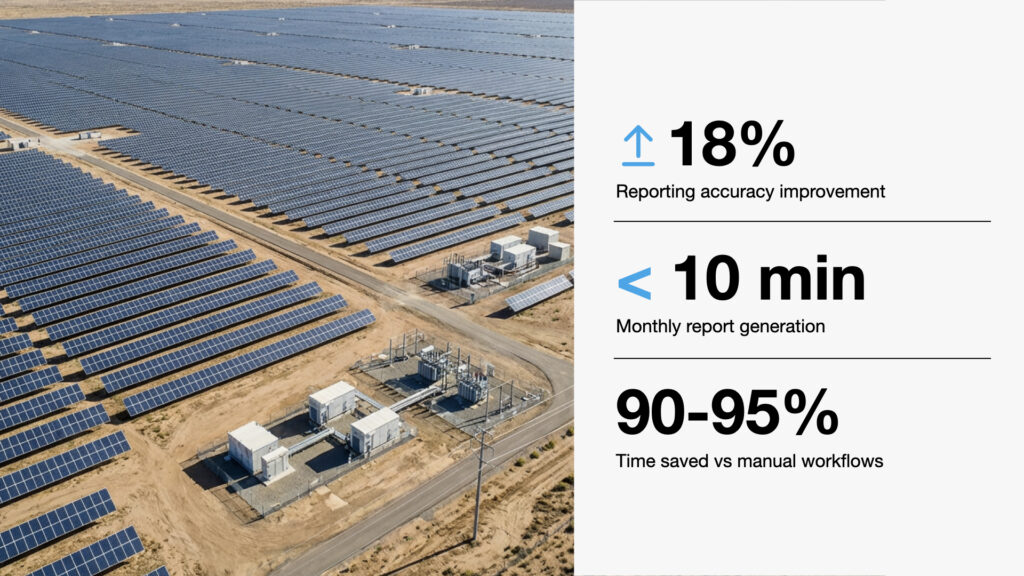
AI platforms can apply pattern recognition and historical context to classify alarms by severity and root cause. The system learns which alarms typically resolve on their own, which ones signal genuine equipment failures, and which patterns indicate cascading issues across multiple inverters. Engineers receive a filtered, prioritised list rather than a raw dump of notifications. Field trials with Australian operators have demonstrated that this alone can reduce routine alarm analysis from more than forty hours per month to under five minutes.
2. Automated Fault Detection and Root Cause Analysis
Identifying underperforming equipment before it appears in weekly reports is essential for minimising energy losses. AI systems can continuously analyse production data against expected performance baselines, weather conditions, and historical trends. When deviations occur, the platform can suggest probable root causes based on fault signatures learned from past incidents.
For example, if a string of inverters shows lower-than-expected output on a clear day, the system can differentiate between soiling, shading, module degradation, and inverter faults by examining the pattern and duration of the underperformance. This capability extends beyond simple threshold alerts. It provides actionable diagnostic information that allows technicians to arrive on site with the right parts and knowledge, reducing truck rolls and repair times.
3. Intelligent Job Card and Work Order Generation
Once a fault is identified, creating a work order typically involves manually logging into a computerised maintenance management system, describing the issue, assigning priority, and allocating resources. AI can automate this entire workflow. The platform detects the fault, generates a structured job card with relevant context including affected equipment, recent performance data, and recommended corrective actions, then routes the work order to the appropriate technician or contractor.
This automation ensures that no identified faults slip through administrative cracks. It also standardises job card quality, making it easier to track resolution times and identify recurring issues across the portfolio. Operators report that automated job card generation cuts fault-to-action times by more than fifty per cent compared to manual processes.
4. Automated Performance and Compliance Reporting
Monthly and quarterly reports for asset owners, lenders, and regulators are time-consuming to produce. Engineers must extract data from multiple systems, calculate key performance indicators, generate charts, and write summary narratives. AI platforms can automate much of this process by continuously tracking metrics such as performance ratio, availability, energy yield versus forecast, and equipment reliability.
The system can produce standardised reports on demand, formatted to meet specific stakeholder requirements. This frees engineering teams to focus on interpreting results and recommending improvements rather than compiling spreadsheets. It also ensures consistency and accuracy across reporting periods, which is particularly valuable for compliance with lender requirements and regulatory obligations.
5. Continuous SCADA Data Analysis and Anomaly Detection
SCADA systems generate continuous streams of voltage, current, temperature, and irradiance data. Human operators typically review this information reactively when an alarm is triggered or during scheduled performance reviews. AI platforms can monitor SCADA data in real time, detecting subtle anomalies that may not yet trigger conventional alarms but indicate emerging issues.
For instance, gradual voltage drift across a string, slight temperature increases in a particular inverter bay, or inconsistent current patterns can all signal problems weeks before they result in equipment failures or significant energy losses. Early detection enables proactive maintenance, which is invariably less expensive and disruptive than emergency repairs.
6. Natural Language Access to Documentation and Historical Data
Technical documentation, commissioning reports, equipment manuals, and past maintenance records are often stored across multiple systems in various formats. Finding specific information when troubleshooting a fault can take considerable time. AI-powered conversational interfaces allow operators to query documentation using natural language rather than navigating folder structures or scrolling through PDFs.
An engineer can ask the system about similar faults on the same inverter model, retrieve wiring diagrams for a specific combiner box, or find warranty terms for a failed component. The platform understands context and provides relevant answers within seconds. This capability has proven particularly valuable for training new team members and for supporting night-shift operators who may not have the same depth of site-specific knowledge as senior engineers.
7. Predictive Maintenance Scheduling Optimisation
Maintenance schedules are typically based on fixed intervals or equipment manufacturer recommendations. While this approach ensures regulatory compliance, it is not always optimal from a cost or reliability perspective. AI systems can analyse equipment condition data, performance trends, and failure patterns to recommend dynamic maintenance schedules that align interventions with actual equipment needs rather than arbitrary calendar dates.
This does not mean deferring critical safety inspections. Rather, it allows operators to prioritise resources where they will have the greatest impact on availability and performance. For example, if thermal scans indicate that certain transformers are operating well within normal parameters, their servicing can be scheduled during planned outages rather than as standalone site visits. Conversely, components showing early signs of degradation can be addressed before they fail.
Frequently Asked Questions
What O&M tasks can AI automate on a solar farm?
AI can automate alarm triage, fault detection, job card generation, performance reporting, SCADA data analysis, documentation retrieval, and maintenance scheduling. These tasks do not require new physical infrastructure and can be implemented through software integration with existing monitoring and work management systems. The automation handles repetitive analytical work, allowing engineering teams to focus on troubleshooting and strategic improvements.
Does AI reduce site visits or truck rolls?
Yes, substantially. By providing more accurate fault diagnostics and root cause analysis before technicians are dispatched, AI platforms enable operators to send the right person with the right equipment on the first visit. Field experience shows that automated fault detection and intelligent job card generation can reduce unnecessary site visits by identifying transient issues, consolidating multiple minor repairs into single trips, and ensuring that parts and tools are available when crews arrive on site.
How quickly can we see results in Australian conditions?
Most operators observe measurable improvements within four to eight weeks of deployment. Initial gains typically appear in reduced alarm noise and faster reporting turnaround. As the AI system learns site-specific patterns and operators become familiar with the platform, additional benefits emerge in fault detection accuracy and maintenance scheduling efficiency. The speed of implementation depends primarily on SCADA integration complexity rather than geographic factors. Australian solar farms with standard monitoring infrastructure can deploy these tools as quickly as facilities anywhere else.
Do we need new hardware for O&M automation?
No. AI-driven O&M automation is primarily a software solution that integrates with existing SCADA systems, inverters, weather stations, and work management platforms. The platform accesses data through standard protocols and APIs. Operators do not need to install new sensors, replace monitoring equipment, or modify plant hardware. This makes the approach particularly cost-effective and reduces both implementation time and technical risk.
Moving Forward
The gap between solar industry growth and available O&M capacity will not close on its own. Operators who implement intelligent automation today position themselves to manage expanding portfolios without proportional cost increases. The seven tasks outlined above represent practical starting points that deliver fast returns and build confidence in AI-driven tools.
P2AgentX has deployed its P2Chat platform on operational solar farms in Australia, demonstrating that routine analysis time can be reduced from more than forty hours per month to minutes while improving fault detection and response times. The platform requires less than one hour of training and integrates with existing SCADA infrastructure without hardware modifications.
If your organisation is managing utility-scale solar assets and looking to reduce O&M costs while improving reliability, we invite you to see the platform in action. Book a demonstration to explore how AI automation can be implemented on your sites and what results you can expect in the first ninety days.