Every operations manager knows the feeling. You arrive on Monday morning to find 247 new SCADA alerts waiting in your inbox. Three inverters are underperforming. Two string combiner boxes show voltage anomalies. Five irradiance sensors appear to have drifted. The communication gateway logged 43 connectivity warnings over the weekend.
Which one do you tackle first? Which alerts actually matter? And how much revenue are you losing while you try to figure it out?
This is alarm fatigue, and it is costing the solar industry billions. According to the Raptor Maps 2025 Global Solar Report, equipment-related underperformance resulted in nearly $10 billion in unrealised revenue globally in 2024, with the average utility-scale solar facility losing approximately 5.77% of expected output. A significant portion of these losses stems not from a lack of data, but from the inability to turn that data into timely action.
The solution lies in intelligent triage. Priority job cards transform thousands of undifferentiated alarms into a ranked, actionable backlog that tells your team exactly what to fix first and why it matters.
The Problem with Traditional Alarm Management
Modern solar farms generate enormous volumes of operational data. A typical 100 MW site might have several hundred inverters, thousands of string combiners, dozens of weather sensors, and multiple communication gateways, each reporting status updates every few minutes. When something goes wrong—or even when nothing is genuinely wrong—alerts flood in.
Traditional SCADA systems were designed to notify operators of problems, but they were not designed to prioritise those problems intelligently. The result is a flat list of alarms with no context about their relative importance. A critical inverter failure that costs thousands of dollars per hour appears alongside a minor communication hiccup that has no impact on generation. Both show up as red flags. Both demand attention.
This creates several compounding problems. First, operators waste significant time manually sorting through alerts to determine which require immediate action. Second, genuinely critical issues can be buried in the noise, delaying response times and extending downtime. Third, teams become desensitised to alerts, leading to a dangerous complacency where important warnings are dismissed as background noise.
The labour shortage in renewable energy operations exacerbates these challenges. IRENA’s 2023 Renewable Energy Jobs Review found that while solar PV remains the largest renewable energy employer worldwide, workforce growth in operations and maintenance has not kept pace with the rapid expansion of installed capacity. Experienced O&M engineers are in short supply, and those who remain are increasingly overwhelmed by the volume of data they must process.
How Priority Job Cards Work
Priority job cards solve alarm fatigue by applying intelligence at the point of triage. Rather than presenting operators with an undifferentiated list of alerts, an AI-driven system evaluates each alarm against multiple criteria to determine its true impact on plant performance and revenue.
The process begins with continuous monitoring of all plant data streams, including SCADA outputs, inverter telemetry, weather station readings, and historical performance trends. When the system detects an anomaly—whether a hard fault such as an inverter trip or a soft issue such as gradual string underperformance—it does not simply generate an alert. Instead, it assesses the problem across several dimensions.
First, the system calculates the immediate financial impact. An inverter fault affecting 1 MW of capacity during peak production hours has a very different revenue consequence than a string combiner issue affecting 50 kW during low-irradiance conditions. By quantifying the cost of inaction in real time, the system ensures that high-value issues rise to the top of the queue.
Second, the system evaluates urgency based on fault progression. Some problems, such as tracker motor failures, remain static until addressed. Others, such as DC arc faults or thermal hotspots, can escalate rapidly and pose safety risks or cause secondary damage. The triage algorithm flags issues that require immediate intervention separately from those that can be scheduled during routine maintenance windows.
Third, the system considers operational constraints and resource availability. If a technician is already on site working on a nearby issue, the system may elevate the priority of adjacent tasks to improve route efficiency. If a required spare part is not in stock, the system adjusts the timeline accordingly and flags procurement needs.
The output of this process is a job card—a structured work order that includes not only a description of the fault but also its calculated impact, recommended actions, required resources, and suggested priority level. Job cards are automatically routed to the appropriate team members, whether human technicians or, increasingly, robotic platforms capable of executing certain inspection and maintenance tasks autonomously.
Importantly, priority job cards integrate with existing computerised maintenance management systems, ensuring that the triage intelligence flows seamlessly into established workflows. This eliminates the need for manual data entry and reduces the risk that important tasks will be overlooked.
Real-World Impact: From 40 Hours to 5 Minutes
The difference between traditional alarm management and priority job card systems is not incremental. It is transformational.
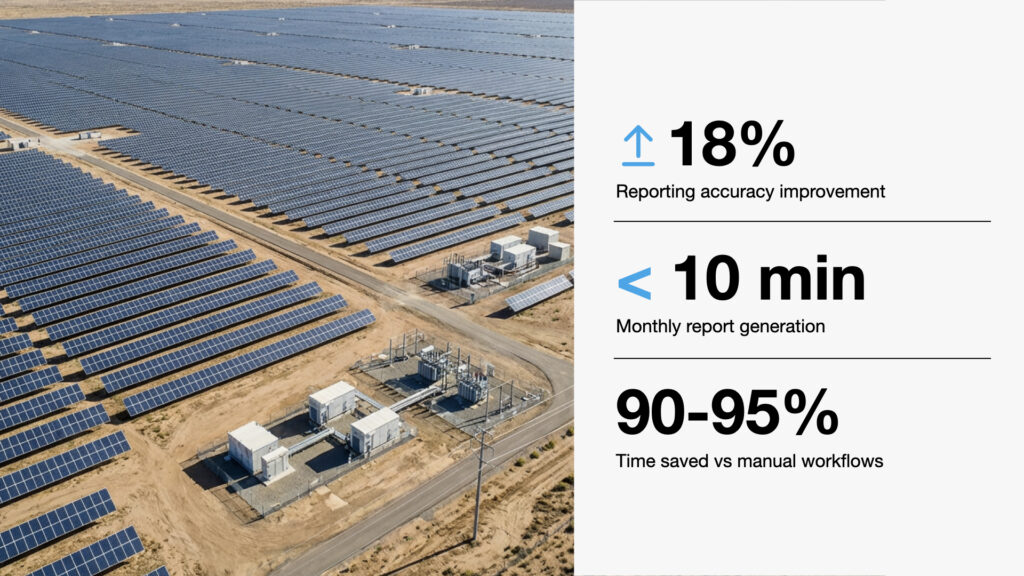
Consider a real deployment of P2Chat Level 2, an AI-native platform that automates fault detection and job card generation for utility-scale solar farms. Prior to implementation, the operations team at a 275 MW site in South Australia spent more than 40 hours per month manually reviewing SCADA logs, cross-referencing performance data, and generating work orders for field technicians. The process was tedious, error-prone, and slow. By the time high-priority faults were identified and assigned, hours or even days had passed, during which generation losses compounded.
After deploying the AI-driven job card system, the same analysis that previously required 40 hours of manual effort was completed in under five minutes. The platform continuously monitored plant data, detected anomalies in real time, classified faults by severity and financial impact, and automatically generated prioritised job cards for the O&M team. Critical issues such as inverter underperformance and irradiance sensor errors were flagged immediately, enabling the team to respond within hours rather than days.
The result was a measurable reduction in fault-to-action time of more than 50%, directly translating into improved plant availability and recovered revenue. The operations team, freed from the burden of manual triage, was able to focus on higher-value activities such as predictive maintenance planning and performance optimisation.
This example illustrates a broader trend in the solar industry. As operations become more complex and workforce shortages intensify, the ability to automate routine analysis and prioritise actions intelligently is no longer a luxury. It is a competitive necessity.
Integration with Existing Systems
One of the most common questions from solar asset owners considering priority job card systems is whether the technology can integrate with their existing infrastructure. The answer is yes, but the quality of that integration varies significantly depending on the platform.
The most effective systems are designed from the ground up to work within the solar industry’s existing technology stack. This typically includes SCADA platforms from vendors such as Schneider Electric, GE, or Siemens; inverter monitoring systems from SMA, Sungrow, or Huawei; and computerised maintenance management systems such as SAP, Maximo, or Fiix.
A well-designed job card platform connects to these systems via standard APIs, enabling it to pull operational data from SCADA, retrieve equipment specifications from asset management databases, and push completed job cards directly into the CMMS for tracking and reporting. This seamless integration eliminates manual data transfers and ensures that all stakeholders—from field technicians to executive leadership—are working from a single source of truth.
Importantly, modern priority job card systems are also designed to accommodate the robotics platforms that are increasingly being deployed for autonomous inspections and light maintenance tasks. When a job card is generated for a task that can be executed by a robotic inspector—such as a thermal scan to identify hotspots or a visual inspection to detect physical damage—the system can automatically dispatch the robot, monitor its progress, and update the job card status in real time. This orchestration of human and robotic workflows represents the next evolution in solar O&M automation.
The Path to High Automation
Priority job cards are not simply a tool for improving efficiency within existing workflows. They are a foundational component of the autonomous solar farm of the future.
The solar industry is moving toward levels of automation adapted from frameworks used in other sectors, such as autonomous vehicles. At Level 0, all monitoring and maintenance are performed manually. At Level 1, operators are assisted by basic data visualisation tools. At Level 2, AI systems detect patterns and generate reports, but humans still make all decisions. At Level 3, AI systems can execute diagnostics and recommend actions under known conditions, with human oversight for exceptions. At Level 4, integrated AI and robotics conduct routine inspections and planned maintenance with minimal human intervention. At Level 5, the plant operates fully autonomously, with adaptive strategies and corrective actions executed without human input.
Priority job cards enable the transition from Level 2 to Level 3 and beyond. By automating fault detection and triage, they free human operators to focus on complex problem-solving and strategic oversight. By integrating with robotic platforms, they enable the physical execution of routine tasks without human presence on site. And by continuously learning from historical outcomes, they improve their prioritisation logic over time, becoming more accurate and more valuable with each passing month.
This progression is not theoretical. Solar farms in Australia and globally are already beginning to adopt these technologies, driven by the dual pressures of rising operational complexity and labour shortages. Asset owners who embrace this transition early will benefit from lower operating costs, higher availability, and improved returns on investment. Those who delay risk falling behind competitors who can operate more efficiently and respond more quickly to emerging issues.
Frequently Asked Questions
What is a priority job card in solar O&M?
A priority job card is a structured work order that includes not only a description of a detected fault but also its calculated financial impact, urgency level, recommended actions, and required resources. Unlike traditional alarms, which simply notify operators of problems, priority job cards apply intelligence to triage issues and present them in a ranked, actionable format.
How do you triage SCADA alarms into actions?
Intelligent triage evaluates each alarm across multiple dimensions, including immediate revenue impact, fault progression risk, operational constraints, and resource availability. The system uses AI models trained on historical performance data and physics-based tools to assess the true significance of each alert, then ranks issues accordingly and generates prioritised job cards for the O&M team.
Can job cards integrate with our CMMS?
Yes. Modern priority job card platforms are designed to integrate with leading computerised maintenance management systems via standard APIs. This enables automated creation of work orders in your existing CMMS, eliminating manual data entry and ensuring that all stakeholders have access to up-to-date information.
What is the impact on response time?
Deployments of AI-driven priority job card systems have demonstrated fault-to-action time reductions of more than 50% compared to baseline operations. By automating the detection, classification, and prioritisation of faults, these systems enable teams to respond to critical issues within hours rather than days, directly improving plant availability and recovered revenue.
Conclusion
Alarm fatigue is not a minor inconvenience. It is a systemic problem that costs the solar industry billions of dollars each year in delayed responses, extended downtime, and lost generation. Priority job cards offer a proven solution, transforming the chaos of undifferentiated alerts into a clear, actionable backlog that enables teams to focus their efforts where they will have the greatest impact.
The technology is mature, the integrations are proven, and the results are measurable. For solar asset owners and O&M providers looking to improve efficiency, reduce costs, and prepare for the autonomous operations of the future, priority job cards represent a critical step forward.
Ready to eliminate alarm fatigue and accelerate your response times? Book a demo to see how P2Chat’s priority job card system can transform your solar O&M operations.