
- Solar asset owners and O&M teams spend 40+ hours per month compiling performance reports that arrive too late to prevent revenue loss
- Automated solar reporting transforms raw SCADA data and documentation into executive-ready summaries in seconds, not days
- P2Chat generates monthly reports with performance metrics, fault root causes, and prioritised actions—no manual assembly required
Solar farms generate enormous volumes of operational data every day. Inverter logs, weather station readings, SCADA alarms, maintenance records, and energy export figures all flow continuously into monitoring systems. Yet when executives, investors, or board members ask a straightforward question—”How did the plant perform last month?”—the answer often takes days to prepare.
The traditional monthly reporting cycle involves downloading CSV files, cross-referencing weather data, calculating availability metrics, investigating anomalies, and formatting findings into slides or PDFs. By the time the report reaches decision-makers, the information is historical rather than actionable. Meanwhile, O&M engineers who should be fixing problems are instead spending hours in spreadsheets.
What Is Automated Solar Reporting?
Automated solar reporting refers to software systems that continuously ingest operational data from utility-scale photovoltaic plants and generate structured performance summaries without manual intervention. Rather than requiring engineers to extract, process, and interpret data, these systems apply algorithms to identify trends, detect underperformance, diagnose root causes, and format findings into executive-ready documents.
The output is not simply a data dump. An effective automated solar report synthesises information across multiple sources—SCADA systems, inverter monitoring platforms, weather stations, and maintenance management tools—to answer the questions that stakeholders actually care about. What was the energy yield compared to expectation? Which equipment underperformed and why? What corrective actions are required, and what is the financial impact of delays?
P2Chat delivers this capability through a conversational AI interface that connects directly to existing monitoring infrastructure. Asset owners receive monthly executive summaries that include performance benchmarks, fault classifications, and prioritised work orders, all generated automatically from live data streams.
Why Manual Reporting Fails at Scale
The solar industry has grown faster than the tools used to manage it. According to the International Energy Agency, global solar capacity exceeded two terawatts in 2024, with installations continuing to accelerate. Yet many operators still rely on manual reporting processes designed for single-site portfolios, not multi-gigawatt fleets.
Manual reporting introduces several structural problems. First, it is labour-intensive. A typical utility-scale solar farm requires between eight and twenty hours of analysis per month to produce a comprehensive performance report. For portfolios with ten or more sites, this workload becomes unsustainable. Second, manual processes are slow. By the time an engineer compiles last month’s data, equipment that should have been repaired weeks ago remains offline, compounding revenue losses. Third, manual reporting is inconsistent. Different analysts apply different methodologies, making it difficult to compare performance across sites or track trends over time.
The Raptor Maps 2025 Global Solar Report quantified the financial impact of these inefficiencies. Equipment-related underperformance cost the global solar industry nearly ten billion dollars in unrealised revenue during 2024, with inverters alone responsible for thirty-seven percent of losses. Much of this underperformance goes undetected or unaddressed because asset owners lack timely, actionable reporting.
How Automated Executive Summaries Work
Automated solar reporting systems operate by establishing direct integrations with plant monitoring infrastructure. P2Chat connects to SCADA platforms, inverter data loggers, and weather stations to continuously ingest performance metrics. The platform applies physics-based models to calculate expected energy yield under actual weather conditions, then compares this baseline to observed output to identify deviations.
When underperformance is detected, the system interrogates historical trends and equipment logs to classify the root cause. Is the issue related to inverter clipping, soiling accumulation, tracker misalignment, or grid curtailment? Each fault category has distinct operational and financial characteristics, and the platform tags anomalies accordingly.
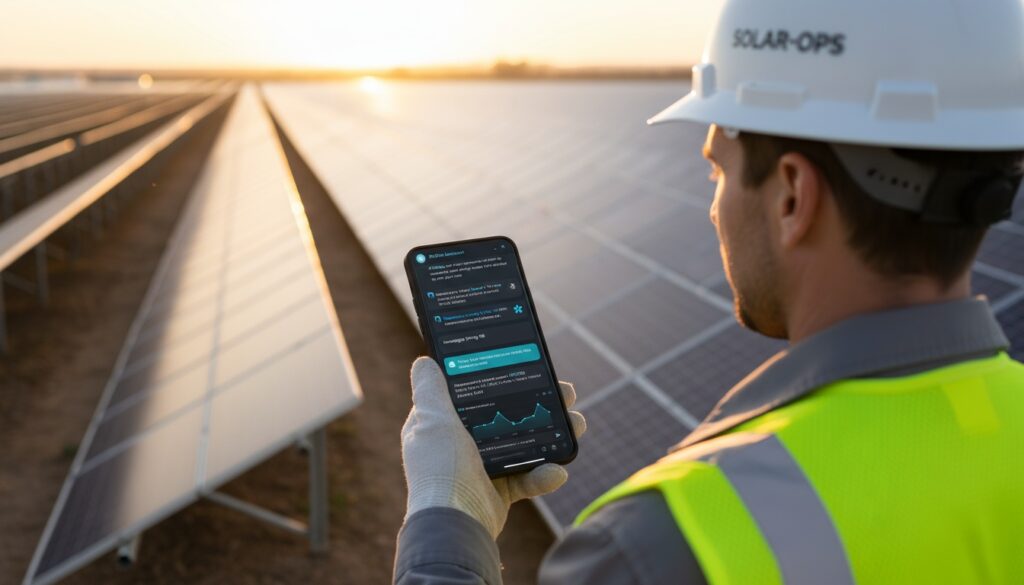
The final step is report generation. P2Chat assembles a structured executive summary that includes key performance indicators such as energy yield, availability, performance ratio, and lost revenue. The report highlights the most significant issues, provides root-cause explanations in plain language, and generates prioritised work orders for O&M teams. Stakeholders receive the summary via email or access it through a dashboard, with drill-down capabilities for those who need additional detail.
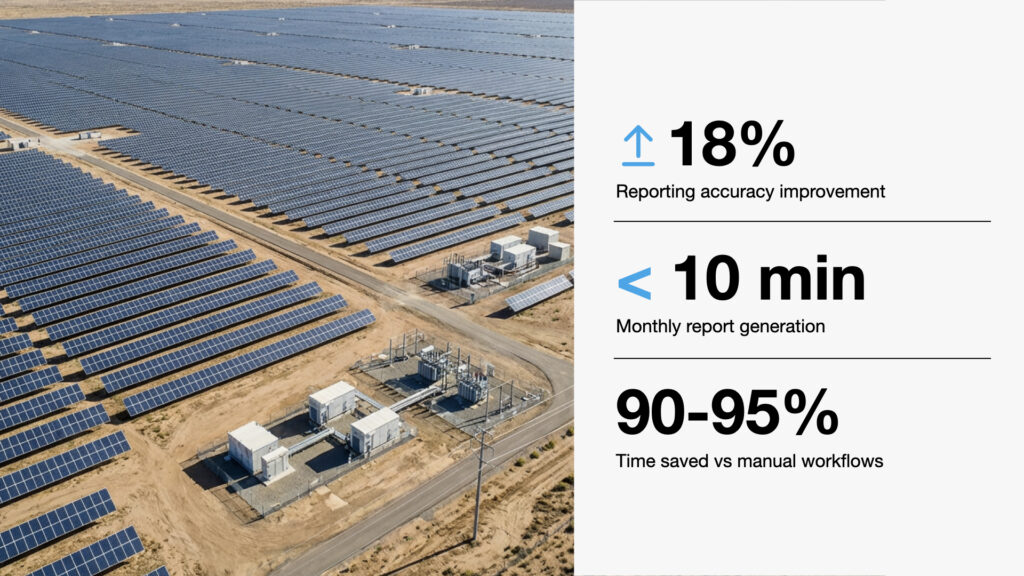
This entire workflow runs automatically on a daily, weekly, or monthly schedule. There is no manual data export, no spreadsheet manipulation, and no time spent formatting slides. The reporting process that once consumed forty hours per month now completes in under five minutes.
What an Automated Solar Report Should Include
An effective automated solar report must answer the questions that matter to different stakeholders while remaining concise enough to be actionable. Asset owners and investors need high-level financial metrics. O&M managers need fault diagnostics and work order priorities. Engineering teams need root-cause analysis and trend data. A well-designed report addresses all three audiences without overwhelming any of them.
The executive summary should open with a performance snapshot. This typically includes total energy production in megawatt-hours, the performance ratio compared to expectation, and the availability percentage. These three metrics provide an immediate sense of whether the plant is operating as intended. If underperformance is present, the summary should quantify the revenue impact based on current electricity prices or power purchase agreement rates.
The second section should classify detected issues by category and severity. For example, a report might indicate that inverter faults caused a two percent energy loss, soiling reduced output by one point five percent, and grid curtailment accounted for an additional half percent. Each category should be accompanied by a brief explanation and, where applicable, a recommendation. Inverter faults may require immediate dispatch of a technician, while soiling losses might trigger a cleaning schedule review.
The final section should present a prioritised action list. Not all faults have equal financial impact, and O&M resources are finite. Automated reporting systems should rank issues by lost revenue or risk of cascading failure, allowing managers to allocate labour and spare parts efficiently. P2Chat generates work orders with sufficient detail that technicians can begin troubleshooting without additional investigation.
Customising KPI Thresholds and Report Templates
Different solar portfolios have different operational priorities. A merchant generator selling power into the spot market cares intensely about real-time availability, while a project financed under a fixed power purchase agreement may prioritise long-term degradation trends. Automated reporting systems must accommodate these differences through configurable thresholds and templates.
P2Chat allows users to define custom performance benchmarks for each site. If an operator considers performance ratios below ninety-five percent to be unacceptable, the system flags any deviation below that threshold. If another operator uses a more conservative target of ninety-three percent, the platform adjusts accordingly. Alarm settings can also be tailored by equipment type. Inverters with known reliability issues might trigger alerts at the first sign of underperformance, while more robust models are monitored less aggressively.
Report templates are similarly customisable. Some asset owners prefer detailed technical appendices with inverter-level data and weather correlation analysis. Others want a one-page summary with three key metrics and a single action item. P2Chat supports both approaches, allowing users to select pre-configured templates or build their own using a drag-and-drop interface. Reports can be scheduled for automatic delivery to specific stakeholders, ensuring that executives receive executive summaries while engineering teams receive the technical detail they need.
This flexibility extends to branding and formatting. Reports can be configured to match corporate style guides, include company logos, and use preferred terminology. For operators who manage portfolios on behalf of multiple asset owners, the platform can generate individualised reports for each client without manual intervention.
Making Reports Audit-Ready for Investors and Lenders
Solar projects are capital-intensive assets that depend on debt and equity financing. Lenders and investors require regular performance reporting to monitor asset health and ensure that revenue projections remain achievable. These reports must meet specific standards of accuracy, completeness, and auditability. Manual reporting processes often struggle to satisfy these requirements, particularly when portfolio managers are juggling multiple sites and tight deadlines.
Automated solar reporting systems designed for institutional investors incorporate features that support audit compliance. All calculations are based on documented methodologies with clear provenance. If a performance ratio is reported as ninety-four percent, the system can produce a detailed audit trail showing the weather data used, the expected yield calculation, the actual energy production, and the ratio formula applied. This transparency is essential when lenders or auditors need to verify figures.
P2Chat maintains an immutable record of all data inputs and report outputs. If a stakeholder questions a figure from a report generated six months ago, the platform can retrieve the original data and reproduce the calculation exactly. This capability is particularly valuable during refinancing negotiations or when disputes arise over performance guarantees.
Reports can also be structured to align with industry standards such as the International Electrotechnical Commission guidelines for PV system performance monitoring. This standardisation ensures that metrics are calculated consistently across different sites and can be compared to industry benchmarks. For asset owners who manage portfolios spanning multiple countries, the ability to generate standardised reports in different languages and regulatory formats is a significant operational advantage.
How Often Should Executive Summaries Be Generated?
The optimal reporting frequency depends on portfolio size, asset criticality, and stakeholder expectations. Monthly summaries are standard for most utility-scale solar operators, as they align with billing cycles, financial close processes, and board reporting schedules. Monthly reports provide sufficient granularity to identify trends without overwhelming recipients with excessive detail.
However, there are cases where more frequent reporting is warranted. Portfolios subject to performance guarantees or liquidated damages provisions may benefit from weekly summaries that provide early warning of underperformance. Sites experiencing equipment failures or grid curtailment events require daily updates so that O&M teams can respond quickly. Automated reporting systems should support flexible scheduling to accommodate these varying needs.
P2Chat generates reports on any schedule the user defines—daily, weekly, bi-weekly, monthly, or quarterly. The platform can also produce ad-hoc reports on demand when stakeholders need immediate answers. For example, if an investor calls asking about last week’s inverter fault, the asset manager can generate a custom report in seconds rather than spending hours compiling data manually.
It is worth noting that reporting frequency should not be confused with monitoring frequency. Automated systems continuously ingest and analyse data in real time, issuing alerts when critical faults occur. The distinction is between passive monitoring, which happens in the background, and active reporting, which delivers structured summaries to decision-makers at defined intervals.
Linking Reporting to Root-Cause Analysis and Job Card Generation
A report that simply presents numbers without explaining their causes is of limited value. Effective automated solar reporting must go beyond identifying underperformance to diagnosing why it occurred and recommending specific corrective actions. This requires integration with root-cause analysis tools and work order management systems.
P2Chat achieves this integration through its multi-agent architecture. When the reporting module detects an anomaly, it triggers diagnostic agents that interrogate equipment logs, weather data, and historical patterns to narrow down potential causes. If an inverter shows reduced output, the system checks for error codes, examines string-level performance, and correlates the timing with weather events or grid conditions. The result is a probabilistic diagnosis that guides further investigation.
Once a root cause is identified, the platform automatically generates a work order with sufficient detail that technicians can begin troubleshooting without additional input. The work order includes the equipment identifier, the fault classification, the suspected cause, and recommended corrective steps. If replacement parts are likely to be needed, the system flags the appropriate inventory items. This seamless handoff from reporting to action dramatically reduces the time between fault detection and repair, which is the most critical factor in minimising revenue losses.
For asset managers overseeing large portfolios, this capability is transformative. Rather than spending hours reviewing reports and manually creating work orders, they receive a prioritised action list with job cards already prepared. O&M teams can begin dispatching technicians immediately, and progress can be tracked through the same platform that generated the original report. This closed-loop workflow eliminates the inefficiencies that plague traditional solar operations.
The ROI of Automated Reporting
The business case for automated solar reporting is straightforward. Manual reporting consumes labour that could be deployed more productively, introduces delays that extend revenue losses, and creates inconsistencies that undermine portfolio-level decision-making. Automated systems eliminate these inefficiencies while improving data accuracy and stakeholder satisfaction.
Consider a typical scenario. An O&M manager responsible for a five-hundred-megawatt portfolio spends forty hours per month compiling performance reports for asset owners. If that manager’s burdened labour cost is eighty dollars per hour, the monthly reporting expense is three thousand two hundred dollars, or thirty-eight thousand four hundred dollars annually. Automated reporting reduces this workload to under five hours per month, freeing the manager to focus on fault resolution, vendor management, or strategic planning.
The more significant benefit is the reduction in unplanned downtime. According to the Raptor Maps report cited earlier, utility-scale solar farms lost an average of five thousand seven hundred twenty dollars per megawatt in 2024 due to equipment underperformance. Much of this loss is attributable to delayed fault detection and slow response times. Automated reporting systems that generate daily summaries and prioritised work orders can cut fault-to-action time by more than fifty percent, directly reducing lost revenue.
When these savings are combined with improved investor confidence, faster financing approvals, and better portfolio-level decision-making, the return on investment for automated reporting systems typically exceeds three hundred percent within the first year. For operators managing gigawatt-scale portfolios, the annual savings can reach millions of dollars.
What does an automated solar report include?
An automated solar report includes key performance indicators such as energy yield, performance ratio, and availability percentage. It identifies equipment faults by category and severity, provides root-cause analysis for significant underperformance, and generates prioritised work orders for O&M teams. Reports are structured to serve both executive summaries for stakeholders and detailed technical appendices for engineering staff.
Can we customise KPI thresholds?
Yes. Automated reporting platforms allow users to define custom performance thresholds for each site or equipment type. Alarm settings can be tailored to reflect operational priorities, and report templates can be configured to include preferred metrics, branding, and formatting. P2Chat supports both pre-configured templates and user-defined custom layouts.
Is the report audit-ready for investors?
Automated solar reports generated by platforms designed for institutional investors meet audit compliance standards. All calculations are based on documented methodologies with full provenance, and the system maintains an immutable record of data inputs and report outputs. Reports can be structured to align with industry standards such as IEC guidelines for PV system performance monitoring.
How often can summaries be generated?
Automated reporting systems support flexible scheduling, from daily updates to quarterly summaries. The optimal frequency depends on portfolio size, asset criticality, and stakeholder expectations. P2Chat can generate reports on any schedule the user defines, and it also supports ad-hoc reporting for immediate inquiries.
Moving from Reactive to Proactive Operations
The transition from manual to automated solar reporting represents more than a productivity improvement. It signals a fundamental shift in how asset owners manage their portfolios. Manual reporting is inherently reactive. By the time an issue appears in a monthly report, the opportunity to prevent revenue loss has passed. Automated reporting enables proactive operations, where faults are detected, diagnosed, and resolved before they accumulate significant financial impact.
This shift aligns with broader trends toward autonomous solar farm operations. As portfolios grow larger and O&M teams become more distributed, the industry cannot rely on manual processes to maintain performance. Automated reporting is a foundational capability that enables higher levels of autonomy, from AI-assisted fault detection to robotic inspections and eventually full lights-out operations.
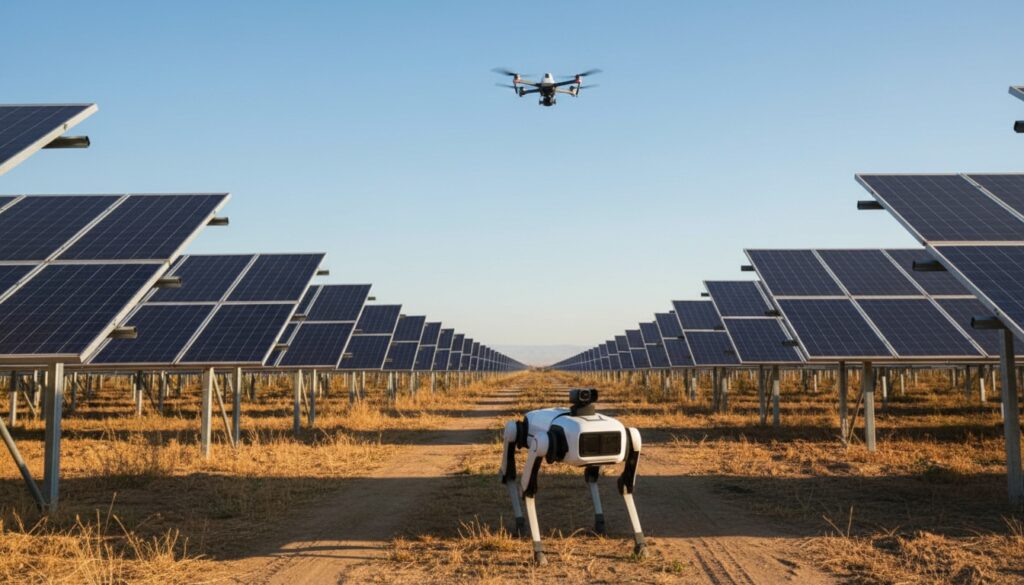
P2Chat is designed to support this evolution. The platform currently delivers automated reporting and job card generation, but it is part of a broader roadmap that includes orchestration of O&M workflows, integration with robotic inspection platforms such as P2Dingo, and supervisory control over plant operations. Asset owners who adopt automated reporting today are positioning themselves to take advantage of these advanced capabilities as they mature.
Next Steps
Solar asset owners and O&M managers who spend more time compiling reports than fixing problems should consider whether their current processes are sustainable as portfolios scale. Automated solar reporting is no longer an emerging technology. It is a proven capability that delivers measurable improvements in labour efficiency, fault response times, and revenue protection.
P2AgentX offers demonstrations of P2Chat to asset owners and operators interested in exploring automated reporting. The platform integrates with existing SCADA and monitoring infrastructure without requiring hardware modifications or disruptive installations. Pilots can be deployed on a single site to validate performance before expanding to larger portfolios.
For those ready to move beyond reactive reporting and toward proactive operations, the first step is to assess current reporting workflows and quantify the time and cost spent on manual processes. The second step is to define the reporting requirements that matter most to your stakeholders. The third step is to schedule a consultation to discuss how automated reporting can be tailored to your portfolio.
Solar farms generate enormous value, but only when they operate reliably. Automated solar reporting ensures that decision-makers have the information they need to protect that value, delivered in seconds rather than days.
Book a meeting to discuss how P2Chat can transform your reporting workflow, or subscribe to receive updates on autonomous solar operations and AI-driven asset management.